SEPTEMBER 2023 RELEASES
September 2023 Releases
Apple’s upcoming iOS 26 introduces enhanced call-screening controls—currently in private beta, with a public roll-out expected in September 2025. These controls give iPhone users granular options for handling calls from numbers they don't recognize.
For enterprise contact centers managing high-volume outbound campaigns, that’s a signal shift: your call flows and connection metrics are now subject to new user-level filters.
In this guide, we break down the new settings you need to understand, how adoption is likely to unfold, and the proactive steps your team should take now to preserve performance, starting with a stronger emphasis on multi-channel outreach and branded caller ID (BCID).
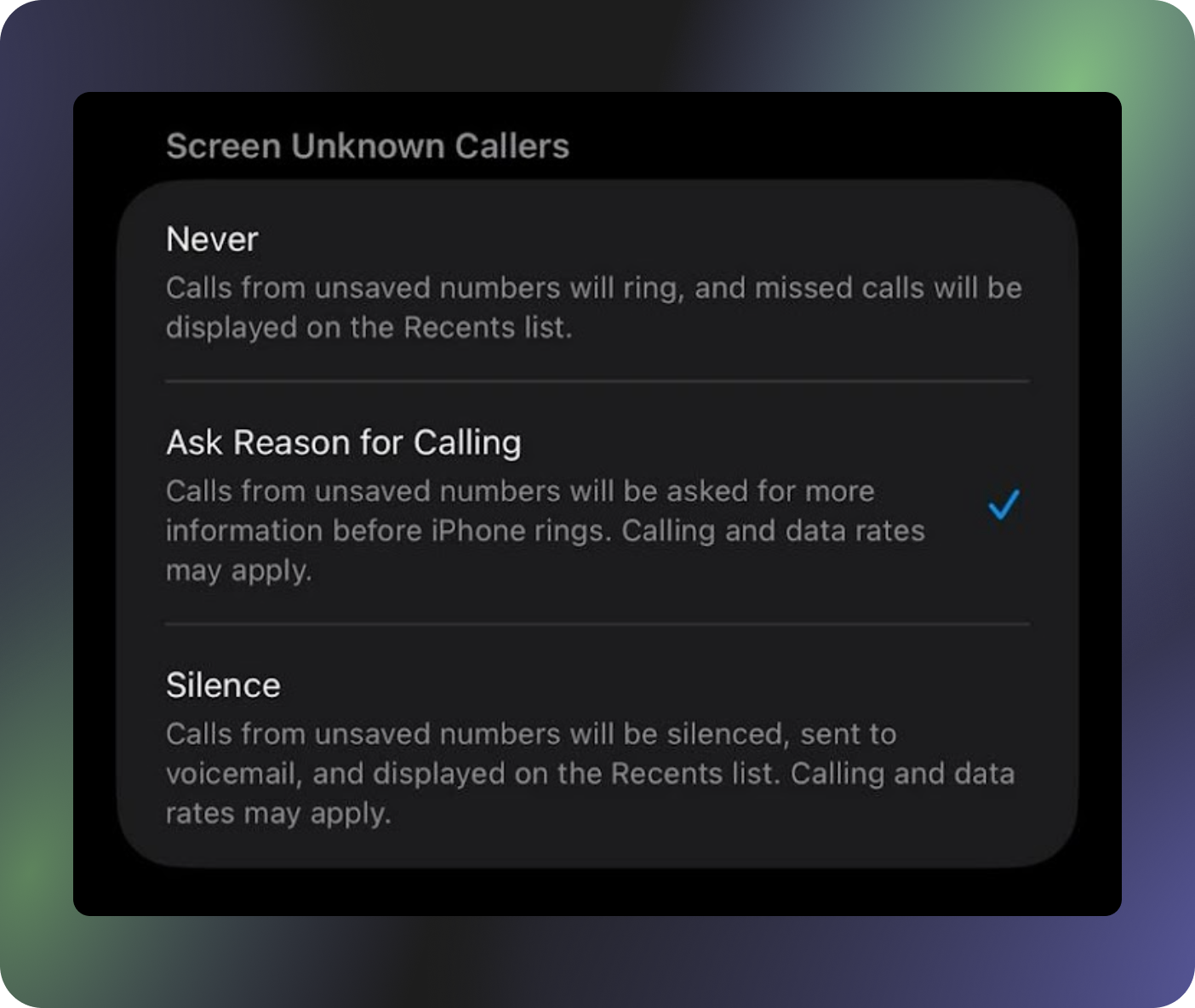
With iOS 26, Apple is giving users greater control over how they manage calls from numbers not in their contacts. The new Screen Unknown Callers setting, which isn’t enabled by default, will likely see gradual adoption. It introduces three distinct options for handling inbound calls:
For operations leaders, a few details are worth noting. Apple isn’t providing transparency into whether a call was screened, silenced, or answered, so teams won’t be able to directly observe device-level outcomes. And while early testers have flagged reliability issues, experience suggests Apple will refine the feature over time.
%20copy.png)
From a business perspective, iOS 26’s screening controls won’t overhaul the customer experience overnight, but they do represent a steady shift that enterprises must anticipate.
Adoption is likely to follow a gradual curve, with meaningful uptake not expected until late 2026. As that happens, answer rates for calls from unknown numbers will start to decline. Because Apple isn’t providing screening signals, teams will need to rely on their own instrumentation to monitor changes, separating customer preferences from system behaviors. The impact won’t be immediate, but leaders who track these trends now will be better prepared to act when adoption accelerates.
The changes in iOS 26 don’t mean outbound calling becomes ineffective, but they do require a more deliberate strategy. Leaders who act early can protect answer rates and build stronger customer trust. Enterprise contact centers can adapt by concentrating on these four actions:
.png)
Caller screening is changing how customers experience phone outreach, but it doesn’t have to erode your performance. Enterprises that lead with branded caller ID, establish data-driven baselines, and embrace multi-channel strategies will not only maintain connections but also stand out as trusted voices in a crowded, screened environment. In a world where “unknown caller” is increasingly ignored, trust is the differentiator, and Regal is here to help you deliver it.
Ready to prepare your team for iOS 26? Schedule a demo to see how branded caller ID and multi-channel orchestration can work together to protect your answer rates.
iOS 26 adds a Screen Unknown Callers setting (off by default) with three options: Never (all calls ring through), Ask Reason for Calling (caller states name/purpose before a transcription notifies the recipient), and Silence (unsaved numbers go straight to voicemail).
As adoption grows, answer rates for calls from numbers not saved in the recipient’s contacts are likely to decline. The effect should build gradually rather than immediately.
Apple isn’t providing signals indicating whether a call was screened, silenced, or answered. Teams will need to rely on their own instrumentation to monitor trends and separate customer preferences from system behavior.
The feature is in private beta now, with a public roll-out expected in September 2025. Meaningful adoption is expected to build gradually, with notable uptake not anticipated until late 2026.
Prioritize branded caller ID and logo branding, diversify outreach with SMS, email, and in-app messaging, proactively tell customers which number you’ll use, and baseline answer/voicemail/connection metrics now to measure change over time.


.png)
In this fireside chat, Regal Co-Founder & CEO Alex Levin sits down with Kin Insurance’s Austin Ewell and a360inc’s Henry Davidson to share how their organizations are using AI agents to transform outreach, customer experience, and operational efficiency. They discuss real-world deployments—from qualification and human agent handoffs to complex negotiation workflows—break down the results, and offer practical guidance for leaders adopting AI agents at scale.
.png)
Learn about the difference between single-state and multi-state AI agents, and how each impacts speed, scale, and reliability. Discover when simplicity is enough and when enterprise workflows demand structured orchestration, so you can choose the right design for your use case.

Discover how you can use Simulations to evaluate scenario-specific conversational flows that pinpoint AI Agent failures before launch. Speed up regression testing, validate prompts, knowledge bases, and custom actions at scale, and deploy reliable AI Agents with confidence.
Learn how to maintain a clean, reliable RAG system for AI Agents. Discover best practices for structuring source docs, chunking content, titling for retrieval, avoiding redundancy, and keeping knowledge bases fresh to ensure accurate, scalable performance.
.png)
This article outlines the core characteristics that influence how voice AI is perceived on live calls. From mechanical traits like speed and volume, to more emotional and conversational behaviors, we’re going to look at what those characteristics mean, why they matter, and how they impact your bottom line.
.png)
Learn how to configure your AI Voice Agent for real performance. This guide covers the most important voice settings in Regal, what ranges top brands use in production, and how adjusting speed, tone, and responsiveness impact cost, containment, and overall customer experience.
AI Agents for Education are transforming student engagement—boosting enrollment, improving retention, and making support more human. Discover 8 game-changing use cases that free up your staff while delivering better student outcomes.

Regal is officially one of Forbes America’s Best Startup Employers 2025, ranking #164 out of 500. This recognition is a testament to our incredible team, our innovative work culture, and our unwavering commitment to advancing AI technology.

AI in education is helping to streamline admissions, automate student engagement, and enhance higher ed outreach. Discover key education technology trends to boost enrollment and learn why automated student engagement tools are the future.
.webp)
When it comes to comparing AI Agents vs. AI Assistants, Siri & Alexa handle simple tasks, but Gen AI Voice Agents—like Regal’s AI Phone Agent—drive real business impact with human-like conversations, automation, and seamless integration.

As AI technology continues to evolve, the use cases for AI Voice Agents in contact centers will only increase. By answering these six key questions, you can identify where AI agents fit best today in your contact center and plan for future integrations.

Consumer businesses are implementing AI-enabled customer experiences without any change in behavior on the part of consumers, which is leading AI to become common with more speed than past transitions like the internet and the smartphone. And it means that the next step in AI will not come from the LLM providers. The next big step forward in AI rests in the hands of consumer businesses.

Explore Eric Hauser's remarkable career journey from GovTech to healthcare disruption at Cadence, highlighting the transformative power of innovation, collaboration, with a special focus on the pivotal role of Regal in driving patient engagement and outcomes.

Discover how Regal.io's AI-powered personalized outreach solutions are revolutionizing outbound sales and customer experience across industries like healthcare, finance, and insurance in our latest eBook, "Modernizing Outbound Contact Centers: How to Treat Millions of Customers like One in a Million."
.jpeg)
Combining collaboration functionality into CCaaS workflow tools invites more cross-functional users from a company to participate in designing the end-customer experience, leading to better omni-channel orchestration and customer outcomes. Learn more about Regal's collaboration features.

Jon Heaps, former VP, Channel at Observe.ai, Talkdesk, and inContact interviews Alex Levin, Co-Founder & CEO of Regal.io, about the history of the contact center industry and some of the key challenges teams making outbound calls face as customers demand more online experiences.

Are you using Branded Caller ID for outbound calls or SMS? New SMS and Branded Caller ID regulations rolled out in Q2 2023 that you MUST KNOW ABOUT. The new regulations require that every company register their SMS campaigns and Branded Caller ID campaigns before being allowed to send texts or brand calls.

Regal’s Conversation Intelligence drives higher conversion rates for B2C sales teams. We use both the traditional QA/coaching tools, and brand new conversational triggers that allow you to update customer profiles and send automated follow up messages based on what is said in a conversation.

We are excited to announce Regal Call Branding™ including Branded Caller ID. Available on all 400M wireless devices in the US (as well as most of Canada and the UK), Regal Call Branding™ puts you in control of what people see when you call their cell phone – including showing your brand and/or logo.

Get behind-the-scenes insights about Perry Health’s 23% revenue increase with Regal.io. Perry Health’s Scott Chesrown sat down with Regal.io and discussed how they implemented outbound sales technology, integrated new capabilities into their process, and built on their early success.

It’s the holiday season and you’d like to hit your December revenue goals. Outbound B2C sales during the holidays can be a major performance driver – if you're prepared and you have the right tools in place. Use these seven tips to get your outbound B2C sales in shape for holiday success.
.png)
Learn how to structure a knowledge base that keeps AI Agents accurate and on-script. Discover why human-style KBs fail, and apply best practices like single-topic chunking, concrete instructions, and explicit outcomes to reduce hallucinations and scale reliable RAG performance.
.png)
In February, we made AI agents sound and feel more natural, even when handling complex, multi-step conversations with conditional logic. These updates give you the control to build AI agents that don't just follow a script: they adapt, respond, and engage naturally with each customer.
Ready to see Regal in action?
Book a personalized demo.





.webp)


.png)
.png)

.png)
.png)


%20(1).png)
.png)
%20(1).png)
.png)
.webp)
.webp)
.webp)
.webp)
%20(1).png)
%20(1).png)
%20(1).webp)
.webp)
.webp)
.webp)
.webp)
%20(1).webp)

.webp)


%202.webp)


.webp)
.webp)
.webp)
.webp)


.avif)


